How to Read Your Shamrock Invoices Line by Line
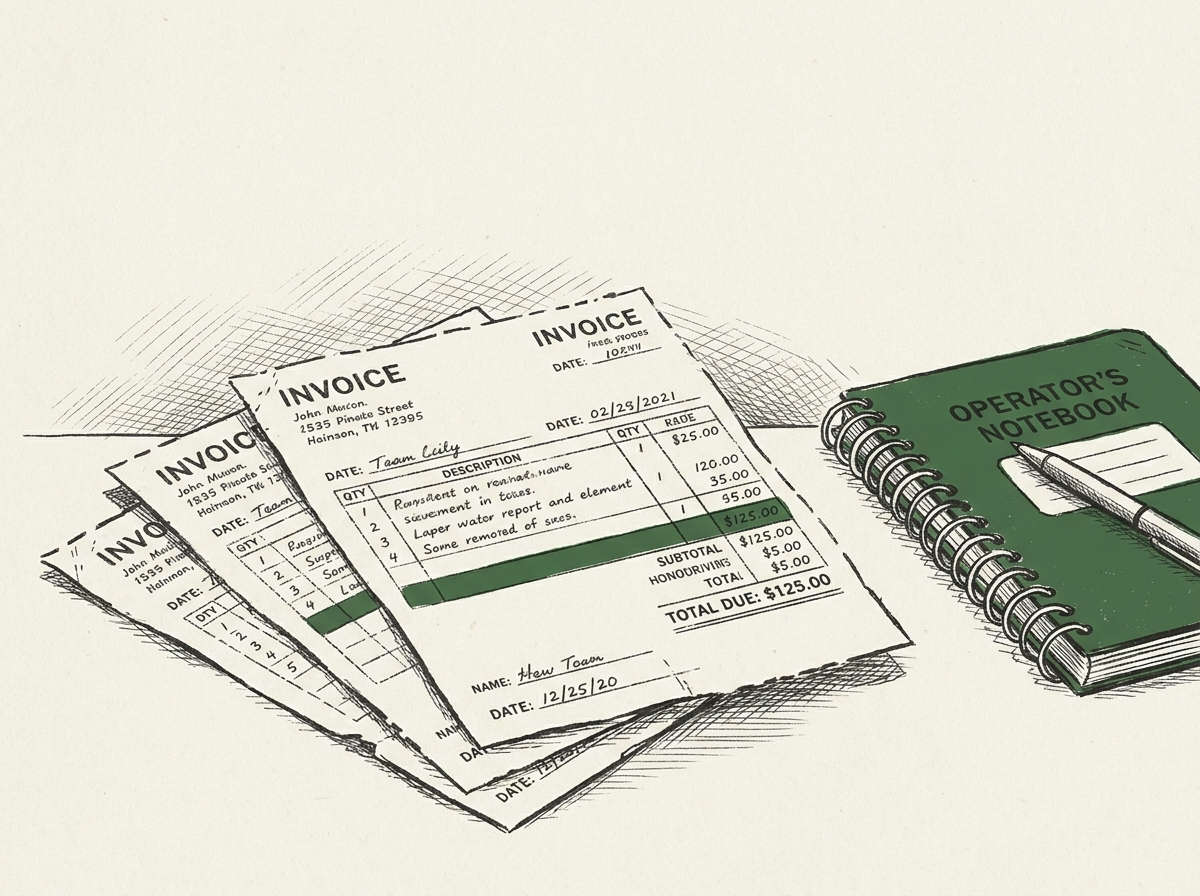
We've been reading vendor invoices line by line for twenty years.
Not glancing at the totals. Not "spot-checking the big stuff." Reading every line, week after week, on Shamrock invoices that show up at the back door full of staples we order on repeat — proteins, produce, dry goods, oil, the things you stop noticing because they show up so reliably.
Most operators don't. They sign the totals and file them. We did the same thing for a long time before we started actually reading them. The first month we switched, we caught a fuel surcharge that had drifted from 4% to 6.5% with no notice. The second month, a substitute brand of coconut milk got billed at the price of the spec'd brand instead of the substitute's price. The third month, a credit we'd been promised six weeks earlier finally hit the invoice — only because we'd kept a one-line tracker and emailed the rep when it didn't show.
None of those individually are huge. Each one cost less than a cover. But on a restaurant doing $1.2M in vendor spend, a quiet 1.5% in surcharge drift, mis-billed substitutes, and unclaimed credits is $18,000 a year. That's a line cook. That's two months of lease. That's the difference between the Q4 you're proud of and the one you absorb.
The audit takes 30 minutes a week if you have the right sheet open. The sheet is at the bottom of this post. Free, no email gate.
The seven things to look at on every Shamrock invoice
For years we'd been told to "watch your food costs." That advice is roughly as useful as "watch your weight" — true, vague, hard to act on. The version that actually works is to break the invoice into seven categories where vendors quietly add or change charges, and to look at one category per pass instead of trying to read the whole invoice cold.
This is the order we run.
1. Surcharges (the line at the bottom you've stopped reading)
Foodservice distributors in 2026 — Shamrock, Sysco, US Foods, PFG, Gordon — all show fuel, handling, environmental, and special-delivery surcharges at the bottom of the invoice. They're presented as percentages, not dollar amounts, which makes them harder to feel.
The trap: surcharges drift up. A fuel surcharge that was 4% in January quietly becomes 5.5% in March, then 7% in May, then back to 6% in July when oil dips. Your invoice header doesn't change. Your rep doesn't email you. The line item just reads FUEL SURCHARGE 6.0% and you sign.
What to do: pull the last 12 invoices, list the surcharge percentage from each, sort by date. Any week where it changed without notice is a credit conversation. They will not refund automatically — you have to ask, and you have to ask in writing.
2. Unit-price drift on staples
We have fifteen items we order every single week. Coconut milk. Jasmine rice. Curry paste. Soy sauce. Lime juice. Cooking oil. Basil. Cilantro. Pad thai noodles. Chicken thighs. The proteins and pantry that make Tuk Tuk Tuk Tuk.
These are the items where we should know the unit price by heart. If the unit price moves on any of them, we want to know that week, not at month-end when we're reconciling food cost.
What to do: pull the last 8 weeks of invoices, build a table with the SKU on rows and weeks on columns, and just put the unit price in each cell. The visual pattern is unmissable. Anything that climbed two weeks in a row is a price hike worth questioning.
3. Quantity discrepancies (you got billed for what didn't show up)
This is the one nobody talks about. Distributors invoice what they LOAD on the truck, not what you SIGN FOR at the back door. If your kitchen manager doesn't count cases against the invoice at delivery, you have no way to know the case-of-something on line 14 actually arrived.
The fix: someone has to count the truck against the invoice as it comes off. Not later. Not from the kitchen. At the door. Anything missing gets noted on the invoice in pen, signed by the driver, and photographed with a phone before the driver leaves. That's your evidence when you ask for the credit.
If your team isn't doing this, the operational fix is bigger than this article. But just knowing it's a leak is the first step.
4. Substitutions billed at original spec price
When Shamrock substitutes a brand because they're out of your usual one, two things should happen: (1) the substitute item should be flagged on the invoice, and (2) the price should be the substitute's price, not the spec'd item's price. Sometimes both happen. Sometimes neither.
What to do: in the same per-week price table from step 2, watch for unit-price moves that aren't actually price changes — they're substitutions you didn't notice. The clue is usually a small change in the line description. "Coconut milk 13.5oz" might become "Coconut milk 13.5oz - alt brand" with a price 12% higher. Or 12% lower (in which case you got lucky for once, and don't tell them).
5. Credit reconciliation (the credits that are "in the system")
Every operator we've talked to has experienced this. You call your rep about a billing issue, they agree it's wrong, they tell you a credit is "in the system." Six weeks later you've forgotten about it and they've forgotten about it and the credit is sitting in some queue that nobody owns.
We keep a one-line log of every credit we've been promised, with the date, dollar amount, and rep's name. Each week, we scan the invoice for those credit numbers. They show up as CREDIT - INV# XXXX near the bottom, separate from the main line items. If a promised credit isn't on the invoice within 30 days of being promised, it's an email back to the rep with the original ticket number.
Most operators lose 30–50% of credits they're owed simply because nobody's tracking them. The tracker is the cheapest leverage we have on the whole audit.
6. Special charges that show up once and never again
Restock fees. Repackage fees. Manual-pick fees. "Service" fees. Sometimes these show up because something legitimately happened (you sent back two cases yesterday, today's invoice has a restock charge). Sometimes they show up because someone in the warehouse miscoded the order.
What to do: flag any unusual line item the first time you see it. If you can match it to something that actually happened, fine. If you can't, it goes on your credit-request list.
7. Contract rate compliance (if you have a rate sheet)
If you've negotiated a rate sheet with Shamrock — meaning, specific items at specific prices for a defined period — those prices need to actually appear on your invoices. They often don't.
The contract rate sheet is the document distributor sales reps wave around when they're trying to close you. Once you've signed, the rate sheet often goes into a file and the prices on your invoices drift toward "list" or "flex" pricing.
What to do: keep your rate sheet open in another tab. Spot-check three or four contract items per invoice. Any divergence is an automatic credit ask, and it's a fast one to win because the contract rate is in writing.
The 30-minute weekly audit
Here's the rhythm we run on Sunday mornings before service. Same rhythm we've been running for years, with the spreadsheet upgraded once or twice.
- Open this week's invoice and the audit sheet. (Sheet linked at the bottom.)
- Surcharge check. Fill in this week's surcharge percentages on the sheet. Sheet flags any change vs prior week.
- Staples table. Drop in the unit prices for your 10–15 weekly staples. Sheet sorts and highlights anything that moved.
- Quantity check. Cross-reference against the kitchen's signed delivery sheet. Note any short-shipped cases.
- Substitution check. Skim line descriptions for "alt", "sub", or unusual SKUs. Note anything that doesn't match what you ordered.
- Credit check. Open your running credit-tracker. For each open credit, check this week's invoice for the credit line. Mark closed or escalate.
- Contract check. Pick 3–4 items from the rate sheet. Verify they hit on the invoice at the contracted price.
- One email, end of session. Compile any line items that need credit into a single email to your rep, with line items + invoice numbers + dollar amounts. Done.
The whole thing is 30 minutes once you've done it three times. The first run is closer to two hours because you're building the staples table and pulling the rate sheet. After that, it's a Sunday-morning habit.
Two things twenty years of this taught us
First, the credit conversations are easier than you'd think. we had built up this idea that vendors would push back hard, that the rep would get defensive, that it would be confrontational. None of that happens. When you email your rep with three line items and the invoice numbers and the math, the response is "let us look into that" and a credit on the next invoice. The work isn't in the conversation. The work is in NOTICING. Distributors are fine to credit you when you catch something specific. They're not fine to credit a "feeling" that the bill is too high. The audit gives you the specifics. The specifics get you the credit.
Second, this is a habit, not a project. The reason vendor-billing audits are weekly and not quarterly is that the patterns shift. The fuel surcharge that was clean in January creeps in February. The substitute that wasn't flagged in March gets flagged in April. A quarterly audit catches half of what a weekly audit does. We've run this every Sunday for years. The compounding effect is hard to overstate. We've never lost a credit we was owed because the tracker is open. We've never been surprised by a price hike because the staples table catches it the same week. Our Shamrock rep treats us differently because we always show up with line items, never with vibes.
When operators ask us what the trick is, we have to disappoint them. There isn't one. The trick is the habit.
The free sheet
We built a Google Sheet that runs the seven checks above. Tabs for each category, formulas to highlight week-over-week changes, and a credit tracker. Free, no email gate, copy it to your own Drive and modify it for your distributor. It works for Shamrock, Sysco, US Foods, PFG, Gordon — they all structure invoices similarly enough.
→ Get the Vendor Invoice Audit Sheet (Google Sheets, 2026 Edition)
(Live link is being added shortly. If you want it before then, email chayadol@reveallabs.co.)
If you want this audit run automatically against your existing invoices instead of by hand on Sunday mornings, that's what we built reveal. to do — it watches your vendor statements the way the sheet does, but every day instead of every week, and it surfaces the same seven categories without you having to open anything. The sheet does about 80% of what reveal. does. Most operators don't need a tool for it. The ones who do tend to be running 3+ units where the Sunday-morning version isn't sustainable.
What to do this week
- Pull the last 12 weeks of vendor invoices from whoever your primary distributor is. (Shamrock, Sysco, US Foods, PFG, Gordon — same audit applies.)
- Open the audit sheet and run step 1 (surcharge check) end-to-end. That alone should take you 15 minutes.
- Email your rep with whatever you find. The first credit you receive will pay for the time you spent.
- Schedule 30 minutes on next Sunday's calendar to run the full seven-step audit.
If you want the next issue when it lands, join the waitlist — same list as the product, same operators we're writing for first.
— Chayadol